Speckle-Aware Signal Extraction as an Alternative to Complex Methods for ECG-Free Cardiac Phase Detection
Does more algorithmic complexity make ECG-free cardiac timing more accurate? Across 11,000+ echocardiography sequences, we found the opposite: a simple, speckle-aware signal beat every complex alternative we tested.
Nikhileswara Rao Sulake1, Sai Manikanta Eswar Machara1, Sivaji Retta1, Iyyakutti Iyappan Ganapathi2, Muhammad Owais2, Irfan Hussain2
1 Rajiv Gandhi University of Knowledge Technologies (RGUKT), IIIT Nuzvid, India2 Khalifa University of Science and Technology, Abu Dhabi, UAE
ASMUS Workshop, MICCAI Society 2026
A simple question about complexity
Echocardiography needs to know exactly when the heart is at end-diastole and end-systole, the two reference points that most cardiac measurements are built around. Normally an ECG signal provides that timing for free, but in point-of-care scanning, and in a lot of retrospective video data, no ECG trace is available at all. The field's working assumption has generally been that solving this without an ECG requires fairly sophisticated machinery: optical flow, Hilbert envelope analysis, multiple signal proxies fused together. We wanted to actually test that assumption rather than take it for granted.
What ultrasound speckle does to these signals
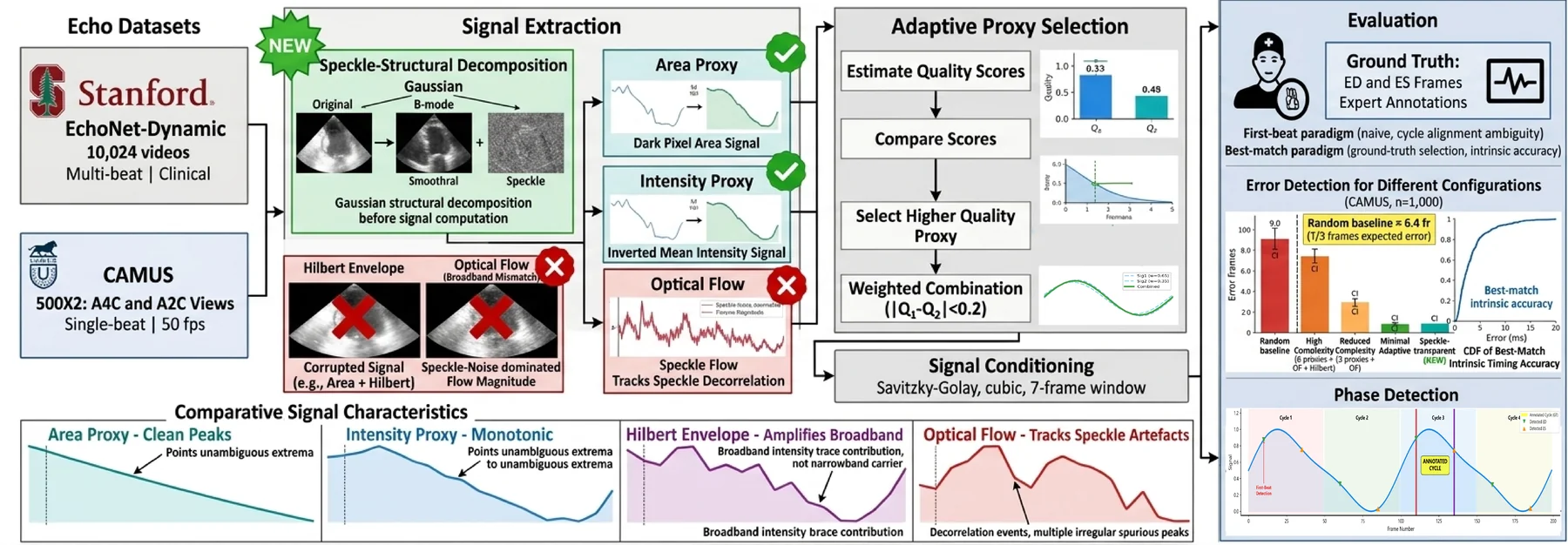
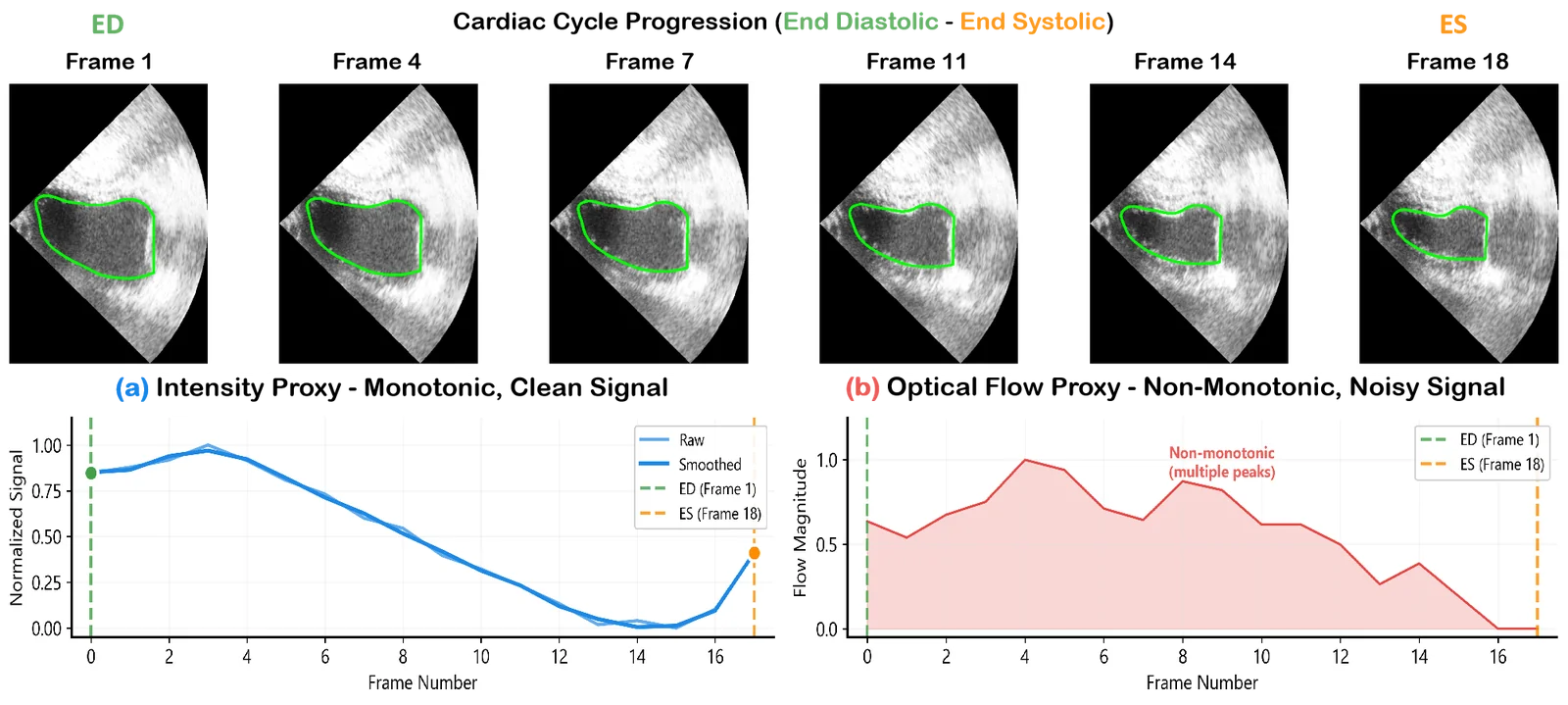
Ultrasound images carry speckle, a granular interference pattern created by sound waves scattering off tissue smaller than the imaging resolution. It looks like noise, and a lot of ECG-free timing methods effectively try to average it away or work around it with more complex signal processing. Our approach does the opposite: it separates the speckle component from the underlying structural B-mode signal first, through a Gaussian decomposition, and then extracts a timing proxy from the clean structural component alone. Once speckle stops corrupting the signal, a much simpler extraction method turns out to work just as well as, or better than, the complicated ones built to compensate for it.
Testing it at scale
We evaluated this across two datasets rather than one: 1,000 sequences from CAMUS and just over 10,000 videos from EchoNet-Dynamic, more than 11,000 echocardiography sequences in total. We also built a formal random-baseline detector, expected to land around one third of the cardiac cycle length in error, so that every method's performance could be judged against a real floor rather than an arbitrary one.
Where complexity actually hurt
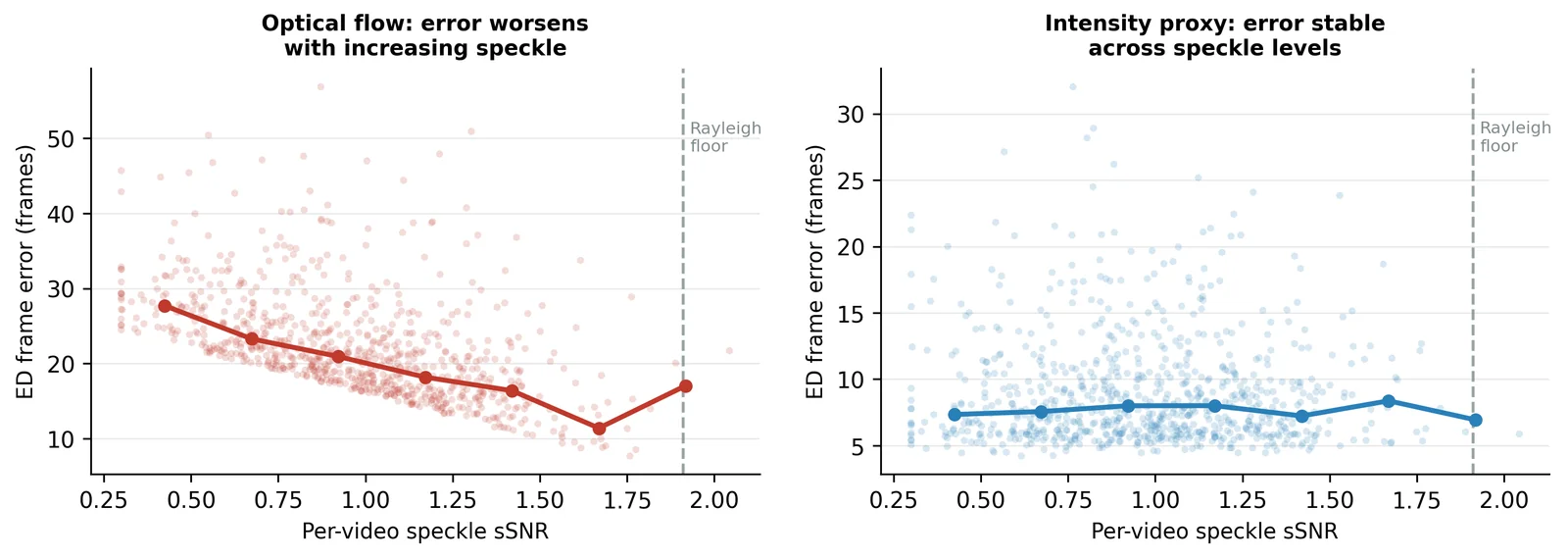
The result surprised us a little, even though it is exactly what we set out to check. On CAMUS, the high-complexity configuration, the one combining optical flow with multi-proxy fusion, produced a median end-diastole error of 9.0 frames. Both our minimal-adaptive and speckle-transparent configurations landed at 1.0 frame. Digging into why, we found that optical flow error roughly doubles as speckle signal-to-noise ratio worsens across the dataset, a fairly direct confirmation that speckle interference, not a shortage of algorithmic sophistication, was the actual bottleneck the more complex methods were fighting.
What we take from this
We are not arguing that complex methods are never useful, only that for this specific problem, adding complexity on top of a signal still corrupted by speckle does not fix the underlying issue, and can make it worse. A simpler, physically grounded extraction step, done before any timing algorithm runs, turned out to matter more than the timing algorithm itself. This is our second paper accepted at an A*-ranked computer vision and medical imaging workshop, following DebrisVision at ICCV 2025, and it will be presented at the ASMUS Workshop, MICCAI Society 2026.